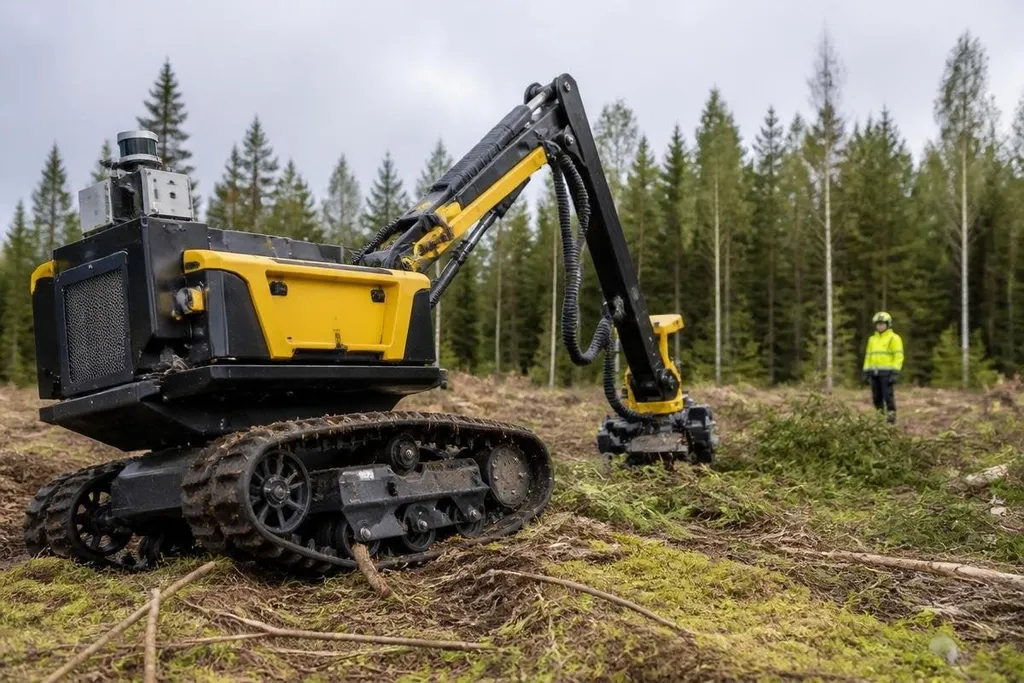
A forestry robot works far from the clean floors used in many automation demos. It must read uneven ground, identify trees, avoid people, and keep working when light, weather, and soil conditions change. AI helps with those tasks by turning camera, LiDAR, and machine data into decisions.
- Cameras can sort trunks, branches, rocks, and people
- LiDAR can measure ground shape and nearby obstacles
- Route software can change the robot’s path when conditions shift
What AI adds to the robot
A normal robot follows set rules. AI lets the system classify what its sensors see, then choose an action from that reading.
A camera may show a vertical shape, while LiDAR measures its height and distance. Together, those inputs can help the robot tell a tree from a post or a person.
That matters because forests rarely offer a clear path. Roots, fallen branches, steep ground, and thick undergrowth can block a planned route. Fixed-map systems may stop when the ground changes; live sensor input can help the robot build a new path around the obstacle.
The system still needs limits. A model trained on dry ground may read wet leaves, snow, or deep shadow poorly. The robot needs a safe response when its confidence drops, such as slowing down, stopping, or asking a remote operator to check the scene.
Where forestry robots can use it
Tree inspection is a direct use. During a survey, the robot can collect images from several angles, record trunk size, and mark signs of damage for later review. The useful output is a consistent record that a forester can check, not a vague health score with no image behind it.
Navigation is another use. The robot can combine wheel or leg movement with GNSS, cameras, and LiDAR to estimate its position. In a dense forest, satellite signals may be weak, so the system may need to match new sensor readings with a local map.
Work tools also gain from better sensing. A cutting arm, gripper, or sampling tool needs the tree’s position before it moves. AI can help locate the target, but the arm still needs force limits, collision checks, and a clear stop command.
Tree type, slope, weather, and repair time can change the result of a forestry robot trial. Forestry robotics reporting from Robot24.com can tie a machine’s claim to those field conditions, the test date, and the work left for people. Those details lead into the limits that decide whether the robot cuts work or adds service calls.
The limits that decide value
Forest work puts pressure on every part of the system. Mud can cover cameras, and rain can change image quality.
Dense branches can confuse LiDAR. A battery that works for a short inspection may not suit a full work period far from a charging point.
Data is another constraint. An AI model needs examples that match the place where the robot will work. Tree species, terrain, weather, and management methods differ between sites. A model may need local data before its results are useful to the crew using it.
Safety needs its own design. People nearby need the robot to detect them, stop its moving tools, and make its state clear. Remote control can help when the system meets a scene it cannot classify, but a human operator cannot watch every robot at every second.
I’d judge a forestry robot by its safe stop behavior before its AI claims.
A practical buying checklist
Use these checks before a pilot or purchase:
- Test the ground: run the robot on slopes, roots, mud, and loose soil found at the work site.
- Check sensor records: ask to see raw images, LiDAR maps, and event logs after a stop.
- Set failure rules: define what happens when the model cannot classify a tree, obstacle, or person.
- Measure operator load: record how often a remote worker must take control during a normal work period.
- Plan the battery: match runtime, charging time, spare batteries, and travel distance to the site.
- Review local data: confirm how the model was trained and whether site data can be added safely.
AI can reduce the amount of manual checking a forestry robot needs, but it cannot remove the need for sound hardware, clear safety rules, and local testing. The next useful measure is simple: how many hours can the robot work safely on the actual forest floor before a person must step in?